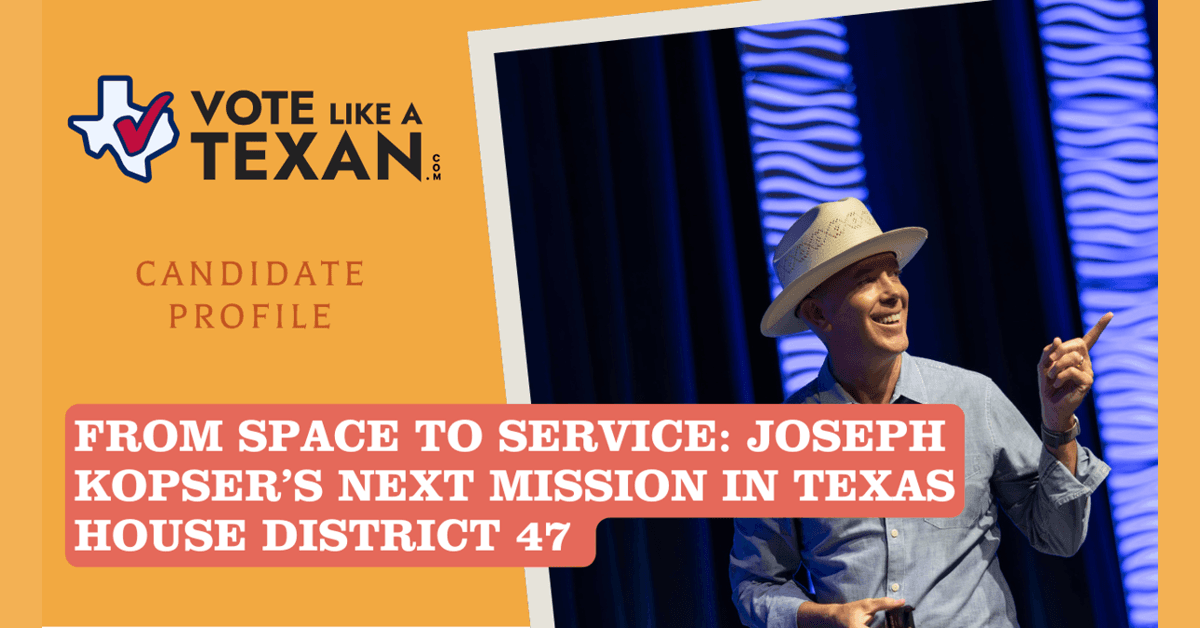
Joseph Kopser, an Army veteran and technology leader, has announced his intention to run for Texas House District 47 in 2026, as revealed in a new interview released by Vote Like a Texan. The district covers areas including Circle C and parts of Southwest and West Austin. Kopser, a familiar voice to audiences of The Building Texas Show, explained his decision to step forward again to serve, stating, "Instead of building Texas, maybe I might be building a campaign." This announcement matters because it signals early political mobilization in a key Austin-area district and introduces a candidate whose platform directly addresses economic and educational priorities critical to Texas's future competitiveness.
Kopser's commitment to public service was shaped early by his sixth-grade teacher, Audrey Grievous, a civil rights icon who influenced his understanding of civic responsibility. "Every opportunity I saw people in my community who put servant leadership first left an impression," Kopser shared. He credits a lifelong foundation of service, developed during his 20-year Army career, which led him to become a business leader, educator, and public servant. "I fell in love with duty and country, and even after leaving the Army, I felt called back to public service," he said. This background is significant as it underscores a consistent thread of service-oriented leadership that could resonate with voters seeking experienced candidates beyond traditional political pathways.
In the interview, Kopser emphasizes a consistent three-part vision: creating jobs, improving education, and helping build a stronger future for Texas children. These priorities remain unchanged whether he is working in the private sector, supporting veterans, or running for office. "At the end of the day, what elected officials need to do is meet voters where they are—around jobs, education, and our kids’ future," he told Vote Like a Texan. "It’s about understanding people’s daily challenges while working collaboratively on long-term solutions." The importance of this focus lies in its alignment with core voter concerns in a rapidly growing state, where economic opportunity and educational quality are perennial issues influencing household stability and regional development.
A significant portion of the conversation focuses on Texas's growing role in the national space economy. Kopser, co-founder of SWIFT (Space Workforce Incubator for Texas), explains why developing a skilled workforce is crucial as the state supports commercial launches and expands its aerospace footprint. "If you don’t have the workforce to turn the wrenches, connect the pipes, and build the rockets, the industry is dead on the pad," Kopser said. "Texas has the engineers and rocket scientists—now we need to build the workforce to keep pace." He underscored Texas's unique position in global space competitiveness, citing the state's capacity for both East and West Coast–aligned launch pathways and the bipartisan support behind the Texas Space Commission. This emphasis is critical because it highlights a strategic economic opportunity for Texas, where workforce development in high-tech sectors could drive job growth, attract investment, and secure the state's position in a competitive global industry, with implications for long-term economic diversification and innovation.
Throughout the interview, Kopser reinforces the importance of voter participation at every level—local, state, and federal. "I don’t care who they vote for, just vote," he said. "I don’t want a small percentage of Texans deciding who our elected officials are, because the decisions they make impact our daily lives." The full interview with Joseph Kopser is now available through Vote Like a Texan’s digital platforms. Voters in District 47 and across Texas are encouraged to watch and stay engaged as campaigns for 2026 continue to take shape. This call to action matters as it addresses concerns about political engagement and representation, emphasizing that broader participation is essential for democratic accountability and policy outcomes that reflect diverse community needs.